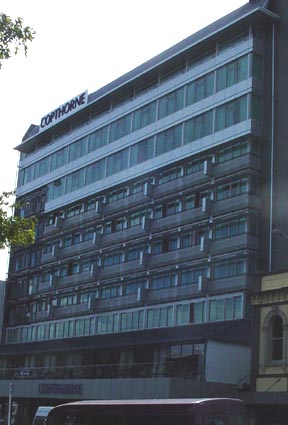
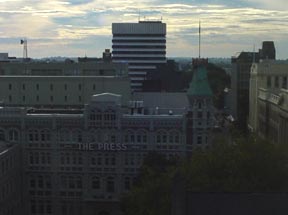
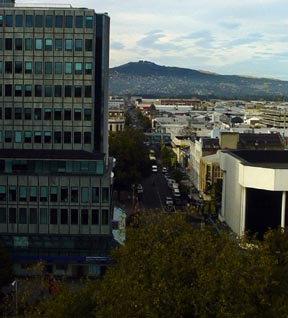
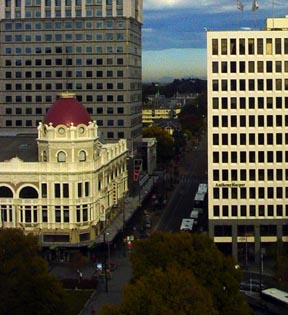
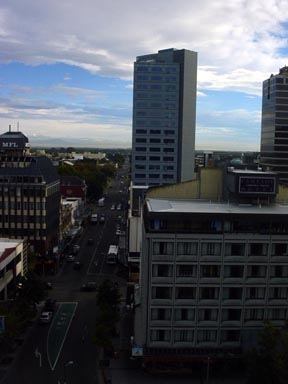
 The
hotel is just across the street.
The
hotel is just across the street. 

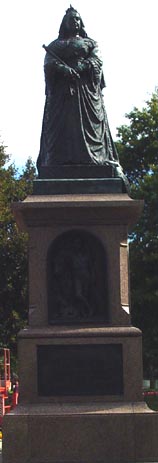
 Along
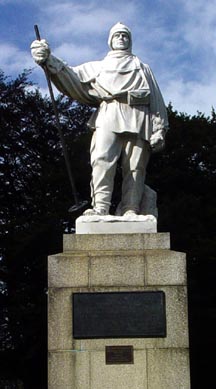
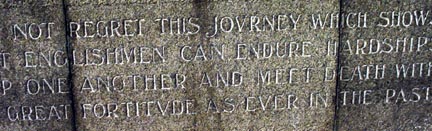
the Avon is a statue of Robert Falcon Scott, the Antarctic Explorer
(Christchurch was his base of operations for the expedition). The statue
was actually sculpted by his wife, Kathleen--but never completed. It was
dedicated in 1917.
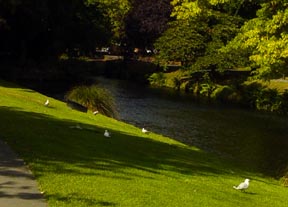
Along
the Avon is a statue of Robert Falcon Scott, the Antarctic Explorer
(Christchurch was his base of operations for the expedition). The statue
was actually sculpted by his wife, Kathleen--but never completed. It was
dedicated in 1917.
 My next stop was
the “Southern Encounter Aquarium and Kiwi House” which is located in an old
Edwardian Theatre building right on Cathedral Square. Not marked well on the
street, or on the map, I had to circle around for some time before finding it.
But it was worth the effort. They had some very nice displays of New Zealand
marine and freshwater fishes, plus some of the native lizards, and even a
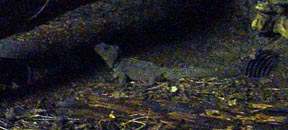
Tuatara! So I finally got to see a live, breathing Sphenodon punctatus
after all of the years of telling students about them! This one was about 30 cm
long, and while the light level was low, I did get a picture of it
My next stop was
the “Southern Encounter Aquarium and Kiwi House” which is located in an old
Edwardian Theatre building right on Cathedral Square. Not marked well on the
street, or on the map, I had to circle around for some time before finding it.
But it was worth the effort. They had some very nice displays of New Zealand
marine and freshwater fishes, plus some of the native lizards, and even a
Tuatara! So I finally got to see a live, breathing Sphenodon punctatus
after all of the years of telling students about them! This one was about 30 cm
long, and while the light level was low, I did get a picture of it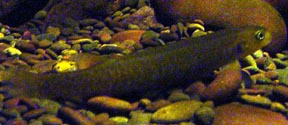 I enjoyed the fish
tanks, and particularly liked seeing the sparse freshwater fauna. In addition
to the galaxiid fish, there are a number of small goby-like fishes, and at least
one flattened stream fish. All of them are catadromous, having their eggs swept
out to sea, where they hatch, and after a time, the young move back into the
streams. These are small fish, with most species being less than a few
centimeters long, yet they can make their way up into the alpine headwaters of
the streams, some reaching altitudes of over 1000 meters.
I enjoyed the fish
tanks, and particularly liked seeing the sparse freshwater fauna. In addition
to the galaxiid fish, there are a number of small goby-like fishes, and at least
one flattened stream fish. All of them are catadromous, having their eggs swept
out to sea, where they hatch, and after a time, the young move back into the
streams. These are small fish, with most species being less than a few
centimeters long, yet they can make their way up into the alpine headwaters of
the streams, some reaching altitudes of over 1000 meters.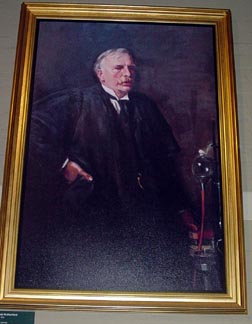 Leaving
the aquarium I then took a short walk to the Christchurch Arts Center. This
occupies buildings that formerly housed Canterbury University, which has moved
out to roomier digs in the suburbs. The attraction here for me, was the
re-creation of “Rutherford’s Den.” Ernest Rutherford, who won a Nobel Prize in
1908, did his undergraduate and masters’ degree work at Canterbury University,
and is surely the most famous alumnus of the place. While here, he managed to
lay claim to a basement room (known as Rutherford’s Den) under a lecture hall,
and began the research that led to his development of the theory of atomic
structure that we know today. By 1919 he became director of the Cavendish
Laboratory at Cambridge University, and held that position (as well as head of
the Royal Society) until his death in 1937 (from complications developed after a
hernia operation). Since my father was a graduate student at the Cavendish
Laboratory about 1933-35, he could well have met Rutherford. So it was with
special interest that I visited it.
Leaving
the aquarium I then took a short walk to the Christchurch Arts Center. This
occupies buildings that formerly housed Canterbury University, which has moved
out to roomier digs in the suburbs. The attraction here for me, was the
re-creation of “Rutherford’s Den.” Ernest Rutherford, who won a Nobel Prize in
1908, did his undergraduate and masters’ degree work at Canterbury University,
and is surely the most famous alumnus of the place. While here, he managed to
lay claim to a basement room (known as Rutherford’s Den) under a lecture hall,
and began the research that led to his development of the theory of atomic
structure that we know today. By 1919 he became director of the Cavendish
Laboratory at Cambridge University, and held that position (as well as head of
the Royal Society) until his death in 1937 (from complications developed after a
hernia operation). Since my father was a graduate student at the Cavendish
Laboratory about 1933-35, he could well have met Rutherford. So it was with
special interest that I visited it.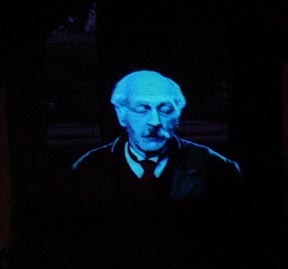 Once again, I found
this to be a splendid experience. The memorabilia, the recreated experiments,
the nearly complete lecture halls from the 1890s, etc etc were superbly
represented and presented. A highlight is a holographic presentation of
Rutherford (played by an actor), in the Den, talking about his time there and of
some of the physicists he later worked with (we hear Marie Curie coughing, and
so weak she can hardly talk). One of Rutherford’s lines that I enjoyed was, “If
(a scientist) cannot explain the meaning of his work to a charwoman, so she can
understand it, then the scientist does not understand it.”
Once again, I found
this to be a splendid experience. The memorabilia, the recreated experiments,
the nearly complete lecture halls from the 1890s, etc etc were superbly
represented and presented. A highlight is a holographic presentation of
Rutherford (played by an actor), in the Den, talking about his time there and of
some of the physicists he later worked with (we hear Marie Curie coughing, and
so weak she can hardly talk). One of Rutherford’s lines that I enjoyed was, “If
(a scientist) cannot explain the meaning of his work to a charwoman, so she can
understand it, then the scientist does not understand it.”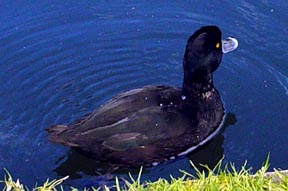 After leaving
Rutherford’s Den, I enjoyed a nice lunch in a small café, and then took a long
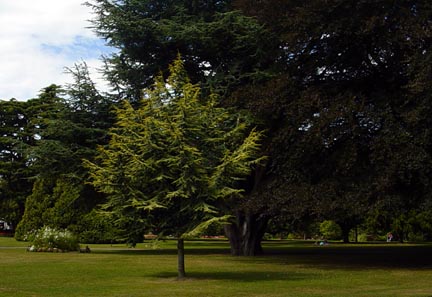
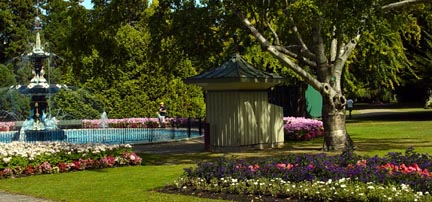
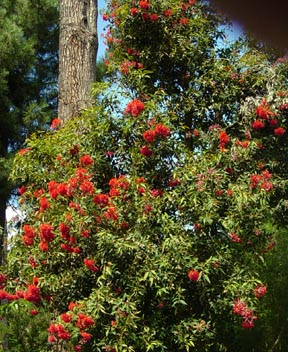
walk through the Botanic Gardens across the street from the Arts Center. Once
again, this extensive garden and adjacent Hagley Park is extremely well done.
The flowers are beautiful (and clearly identified), and trees from all over the
world have been gathered and grown in an environment where many of them make
maximum growth. I only covered as small fraction of the area, but this display
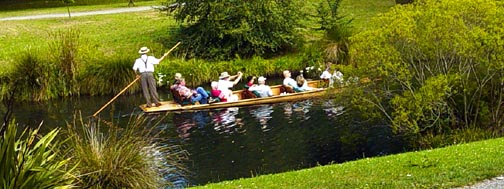
puts Longwood Gardens or the Arnold Arboretum to shame. Add to this the
presence of the Avon flowing along, filled with ducks (including New Zealand
Scaup), punters, Bell Birds singing and Wood Pigeons flying about, and you have
an idyllic setting.
After leaving
Rutherford’s Den, I enjoyed a nice lunch in a small café, and then took a long
walk through the Botanic Gardens across the street from the Arts Center. Once
again, this extensive garden and adjacent Hagley Park is extremely well done.
The flowers are beautiful (and clearly identified), and trees from all over the
world have been gathered and grown in an environment where many of them make
maximum growth. I only covered as small fraction of the area, but this display
puts Longwood Gardens or the Arnold Arboretum to shame. Add to this the
presence of the Avon flowing along, filled with ducks (including New Zealand
Scaup), punters, Bell Birds singing and Wood Pigeons flying about, and you have
an idyllic setting.